
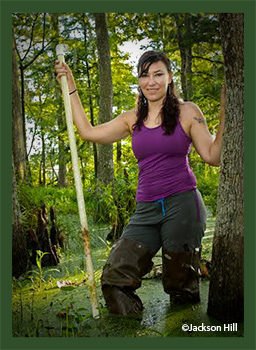
Sarah K. Mack, MSPH, PhD, CFM
President and CEO of Tierra Resources
Sarah K. Mack, Ph.D., is President and CEO of Tierra Resources and is an acknowledged leader in the movement to monetize wetland carbon offsets. In her work, Dr. Mack focuses on innovative approaches to address the global challenges of climate mitigation, urbanization, and pollution through wetland and water management. Dr. Mack led the development and was the lead author of the American Carbon Registry Methodology, Restoration of Degraded Deltaic Wetlands of the Mississippi Delta, the first certified methodology for creating and monetizing carbon offset credits from wetland restoration activities. Dr. Mack leads the implementation of the first wetland carbon pilot projects in the nation that include a freshwater cypress pilot project in partnership with Entergy Corporation, and a mangrove pilot project in partnership with ConocoPhillips. Dr. Mack directs overall activities and works alongside state, municipal, and private partners to generate marketable eco-assets.
Previously Dr. Mack was the Technical Administrator of the Sewerage and Water Board of New Orleans (S&WB) where she also served during Hurricane Katrina as the Emergency Liaison between the S&WB and other agencies responsible for the initial response and later recovery of sewer, water, and drainage infrastructure.
She received her Ph.D. in Global Sustainable Resource Management from Tulane University and is an ASFPM Certified Floodplain Manager.
Robert R. Lane, PhD
Chief Scientist
Robert R. Lane, Ph.D., leads all scientific analyses for Tierra Resources. Dr. Lane was a contributing author on the American Carbon Registry Methodology, Restoration of Degraded Deltaic Wetlands of the Mississippi Delta, and specializes in wetland carbon monitoring and quantification. He is a wetland ecosystem scientist at Louisiana State University (LSU), School of the Coast & Environment, and has published numerous papers in peer-reviewed scientific journals concerning water quality and management of coastal and inland wetland systems. Dr. Lane has extensively studied the impacts of river diversions and municipal effluent application on wetland productivity, elevation, and surface and interstitial water chemistry, as well as the effectiveness of restoration techniques including sediment fences, hydrologic alterations, and municipal effluent application. Dr. Lane received his Ph.D. in Oceanography & Coastal Science at LSU.
John W. Day, PhD
Senior Wetland Ecology Advisor
John W. Day, PhD, is Distinguished Professor Emeritus in the Department of Oceanography and Coastal Sciences, School of the Coast & Environment at Louisiana State University, where he has taught since 1971. Dr. Day has studied Louisiana coastal wetlands for over 35 years, worked with local governments and regulatory agencies regarding wetland restoration, and authored more than 200 articles and books in scientific literature. Dr. Day was a contributing author on the American Carbon Registry Methodology, Restoration of Degraded Deltaic Wetlands of the Mississippi Delta. Dr. Day has extensive experience in the ecology and management of coastal ecosystems in Louisiana and worldwide, with specialization in marsh and forested wetland ecology, wetland and coastal biogeochemistry, and river diversions. He is presently working on using wetlands as a means of removing nitrogen from the Mississippi River and for assimilation of municipal effluents. Dr. Day received his Ph.D. in marine sciences and environmental sciences from the University of North Carolina in 1971.
Jason Day
Field Scientist Lead
Jason Day is a wetland ecologist with extensive experience in vegetation restoration in Louisiana coastal wetlands. Mr. Day has over 20 years of experience collecting field data in southern Louisiana, beginning with Louisiana State University and later with Comite Resources, Inc. Jason leads all field crew operations for Tierra’s Mangrove Air Seeding Initiative and leads all monitoring operations for Tierra’s wetland and forest carbon operations. Jason is a naturalist at heart and can name any vegetation or wildlife species. We rely on Jason to get us out of any tricky field situation. Although Jason is a general bad dude…he is also an amazing chef and has a soft spot for young children.
Robin Lewis
Senior Mangrove Advisor
Mr. Roy R. “Robin” Lewis III is president of Lewis Environmental Services, Inc., and Coastal Resources Group, Inc. Robin specializes in the ecological monitoring, management and restoration of mangrove forests and seagrass meadows and has over 125 professional publications in these and other wetland subject areas. He has forty years of experience in the design and construction of wetlands with over 200 completed and successful projects in the USA and overseas. Robin recently completed the design and permitting of a 1,025-acre mangrove restoration project at the Rookery Bay National Estuarine Research Reserve near Marco Island, Florida. Mr. Lewis has worked and taught wetland restoration in twenty-two foreign countries including Guyana, Jamaica, Bonaire, Nigeria, India, Sri Lanka, Thailand, Indonesia, and Vietnam. Robin is a Professional Wetland Scientist certified by the Society of Wetland Scientists, and a certified Senior Ecologist with the Ecological Society of America.
Laura L. Flynn
Mangrove Scientist
Laura L. Flynn is a Mangrove Scientist for Tierra Resources and the Vice President of Lewis Environmental Services, Inc. Her work as a wetland scientist and practitioner specializes in the restoration and conservation of coastal habitats with a primary focus on mangrove and salt marsh ecosystems. Ms. Flynn assists with the evaluation, permitting, implementation and monitoring of mangrove projects. Laura has served as project manager on a variety of projects and has successfully negotiated permitting of ecologically sensitive projects. Ms. Flynn has 15 years of experience working with Lewis Environmental Services, Inc. in coastal conservation and educational outreach programs. Ms. Flynn received her bachelor’s degree in environmental science from the University of Omaha, Nebraska.
Christina LeBlanc
Marketing and Communications Manager
Christina LeBlanc is the Marketing and Communications Manager for Tierra Resources. In this role, Christina coordinates social media outreach, content creation, website development and maintenance, project management, and landowner outreach. She is responsible for managing Tierra Resources’ GIS mapping capabilities that visually representing the impact of wetland restoration projects along the Gulf Coast. Prior to joining Tierra Resources, Christina worked at Global Green in Client Relations for the NOLA Wise Energy Efficiency pilot program to help renovate homes in New Orleans and reduce energy usage. In this role, Christina supported project design and development to create structures to successfully achieve goals set by the Better Buildings Program of the Department of Energy. Christina holds a B.A. in Diplomacy and World Affairs from Occidental College and M.A.’s in History and Latin American Studies from Tulane University. She is currently completing her Ph.D. in History at Tulane University.